GMS and Hartwig sign MOU to advance precision medicine for cancer patients
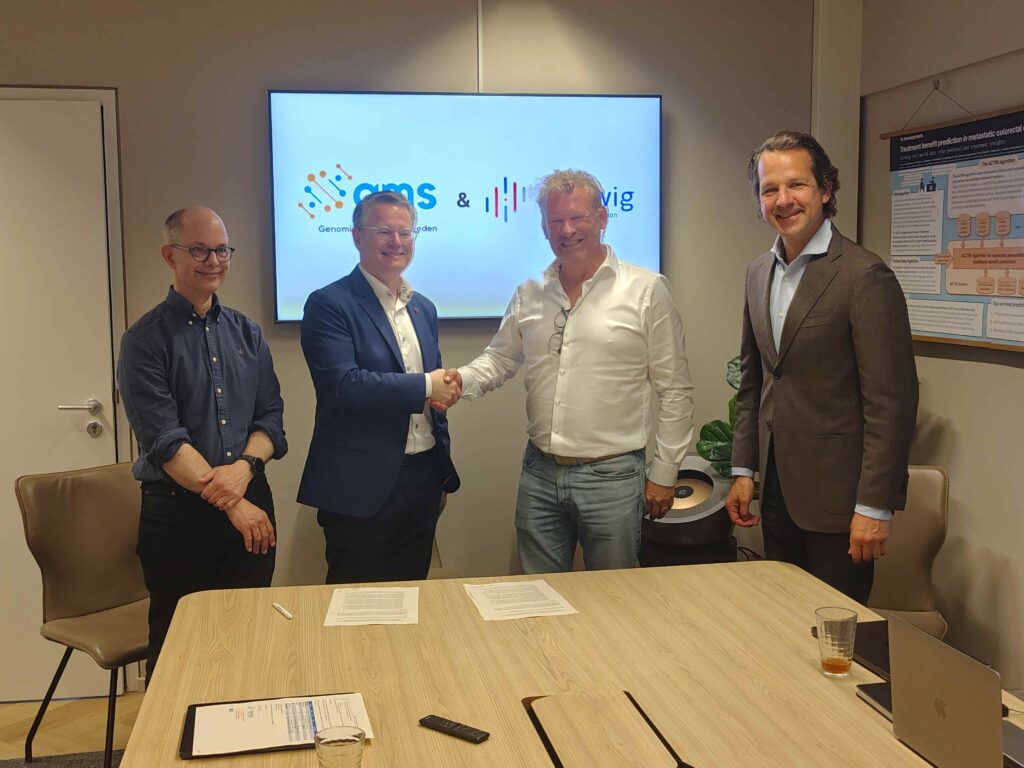
Genomic Medicine Sweden (GMS) and Hartwig Medical Foundation (Hartwig) today signed a Memorandum of Understanding (MoU). This MoU formalises a strategic partnership to accelerate the road to patient impact through the implementation of whole genome sequencing (WGS) and precision oncology in routine care. The collaboration also aims to build a shared foundation for the secondary use of genomic and clinical data across borders.
The collaboration brings together two of Europe’s leading national initiatives in genomic medicine. By combining Sweden’s nationwide infrastructure for genomic diagnostics with Hartwig’s expertise in sequencing, bioinformatics pipelines and database, the parties aim to deliver faster, more equitable access to high-quality genomic diagnostics for cancer patients in both countries and beyond. They also strive to lay the groundwork for international research that benefits patients worldwide.
Direct impact for patients
The MoU sets out four concrete areas of collaboration that will translate into tangible benefits for cancer patients. GMS and Hartwig will jointly advance the clinical implementation of WGS as a default diagnostic tool for adults with acute leukaemia; validate and implement the Hartwig OncoAnalyser comprehensive cancer genomics analysis pipeline for haematological malignancies; benchmark and progressively roll out WGS for selected solid tumours; and harmonise the data models used by both organisations for genomic and associated clinical data.
Together, these activities will shorten the path from sequencing to clinically actionable insight, improve the quality and comparability of diagnostic reports, and ensure that learnings from one healthcare system can be applied to the benefit of patients in the other.
“This partnership is another important step towards making precision oncology a standard, equitable part of cancer care. By aligning our efforts with Hartwig, we accelerate the journey from genomic insight to better outcomes for patients in Sweden and beyond.”
— Richard Rosenquist Brandell, Director, Genomic Medicine Sweden
Building together on secondary use of data
A central ambition of the partnership is to unlock the full potential of genomic and clinical data already generated in routine care. Through joint work on standardisation and harmonisation of data models, GMS and Hartwig will make their data comparable and reusable for research, while demonstrating clinical quality and utility, and enabling the development of new diagnostics and therapies.
In the longer term, this shared foundation is intended to enable federated analyses — allowing researchers and clinicians to ask questions across Swedish, Dutch, and future partner datasets without sensitive data leaving its national jurisdiction. This approach maximally respects patient privacy and national governance frameworks while dramatically increasing the statistical power and clinical insights that can be derived from the underlying data.
You read an article in the category Hartwig Medical Database. You may also be interested in Hartwig Medical Foundation, Learning healthcare system, Molecular diagnostics, Personalized treatment, Research or Whole genome sequencing.“Great science and great patient care depend on great data. By working with GMS on standardisation, harmonisation and, ultimately, federated analyses, we can learn from many more patients than either of us could alone — and put those learnings
back into the clinic faster.”— Edwin Cuppen, Scientific Director, Hartwig Medical Foundation
All news
Also read
Take a virtual tour of our laboratory: from the biopsy to the patient report
What happens to your tumor tissue and blood during a comprehensive DNA test? What exactly does all the complex equipment …

Clinical Cancer Genomics conference, March 20-21 2025, Amsterdam
We are pleased to announce that registration for this novel exciting meeting focused on cancer whole genome and transcriptome sequencing …
Dutch Healthcare Institute approves reimbursement of whole genome sequencing (WGS) for targeted cancer treatment
The Dutch National Health Care Institute (Zorginstituut Nederland, ZiNL) has approved the reimbursement of whole genome sequencing (WGS) through the …
The fact that the CPCT, together with Hartwig Medical Foundation, has managed to bundle data, knowledge and expertise from almost all Dutch hospitals is unique and now also deserves international attention.