From Spreadsheets to Digital Convenience: Hartwig Goes Live With Its Customer Portal

Hartwig Medical Foundation (Hartwig) recently launched its new portal for submitting requests for WGS analysis. For hospitals, this is an important enhancement to the organization’s services, significantly improving both usability and security. The portal also provides treating physicians with more in‑depth information.
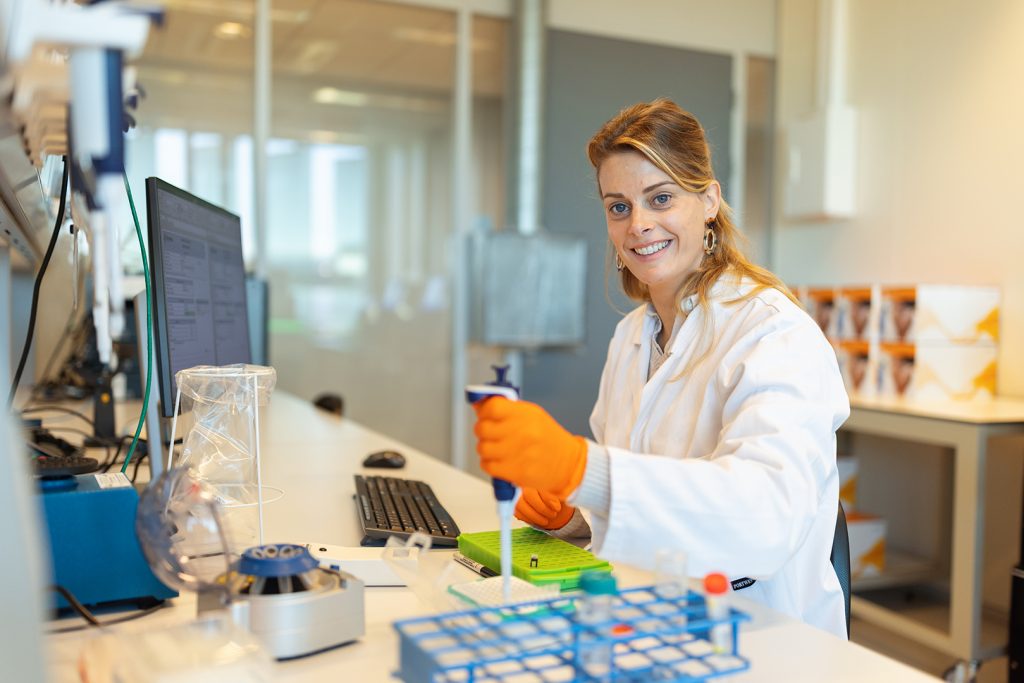
Photo: Left Marloes Willemsen, right Immy Riethorst
With the introduction of the customer portal, Hartwig has taken a major step forward for hospitals that rely on its services. “It has become much more user‑friendly,” says laboratory lead Immy Riethorst. “Previously, all information for registering samples for WGS analysis was exchanged only on paper or through spreadsheets. This sometimes led to outdated versions of forms circulating. We used to send reports to submitters by email, and later through an external online platform, Nextcloud.”
Through the portal, hospitals can directly download patient reports for whom Hartwig has performed sequencing. “Besides being more user‑friendly, it’s also much more secure,” adds lab coordinator Marloes Willemsen. “Sending patient data by email is obviously not ideal.”
Questions About the Report
“What hasn’t changed is the ability to ask Hartwig specific questions or request an explanatory session from our clinical molecular biologists if interpreting the underlying data is complex,” Riethorst explains.
Go‑Live
The online customer portal recently went live for all hospitals that collaborate with Hartwig for WGS analysis, initially to facilitate sharing results. “We asked hospitals what they needed most,” says Riethorst. “Their main priorities were registering samples for WGS analysis and accessing results.”
“Our IT team built and tested the portal based on those needs. First internally, then with one hospital. Based on the outcomes, we gradually expanded access, and the results module is now available to all hospitals. Several are already using it,” Willemsen notes. “We’re rolling it out step by step.”
Thorough Preparation
Hartwig carefully prepared the implementation process for hospitals. “For the larger hospitals, we provided personal demonstrations, partly online and partly in person,” Riethorst says. “We also tested whether access to both modules worked correctly.”
Smaller hospitals received instructions by email, including slides with user guidance. “It wasn’t difficult for users,” Willemsen adds, “because the new workflow aligns closely with what they were already familiar with.” Hospitals now have access to more information—not only the OncoAct WGS report but also the underlying data on which the report is based.
“For us, the portal is also a major improvement compared to how we used to work,” Willemsen continues. “Paper registration forms can be hard to read. We also had to scan and store everything, and delete all PDFs after three months because they contained patient information. It was a lot of work on our end, and the new system is far less error‑prone and much more automated.”
Positive Feedback
The portal is intended for the relevant users: physicians, pathologists, and clinical molecular biologists. Patients do not have direct access. “The underlying data available through the portal means that more specific patient questions can be answered,” Willemsen says. “And the secure way the data is shared is, of course, also in the patient’s best interest.”
Feedback from hospitals has been positive. “Not only because they now have more information available, but also because the system is very user‑friendly,” Riethorst says.

Logging In
“Users at hospitals connected through SURFconext log in with the same account they use within their hospital; access is managed by the hospital. That saves them from having an extra account with another password and two‑factor authentication.”
Users at other hospitals receive a login account for the Hartwig portal, managed by Hartwig.
“For users, it’s clearly indicated which reports are new and which have already been opened or shared,” Willemsen explains. “Any changes we make happen in the background, so they don’t experience any disruption.”
Next Steps
According to Riethorst, the new portal represents a strong first version for sample registration and result sharing. “A system like this is never truly finished,” she says. “We now want to add a dashboard that shows hospitals which information has been submitted, allowing them to track it and immediately see whether everything is complete. We’ll continue adding new features gradually.”
Nothing changes in the analyses and reports Hartwig provides to hospitals. “But the fact that the portal simplifies the logistics of WGS analysis may encourage other hospitals to start using our services,” Riethorst concludes.
More Information
- Hartwig Customer Portal
- Instructions portal results module
- For questions about the portal, contact Hartwig: diagnosticssupport@hartwigmedicalfoundation.nl
- Watch the video ‘How does OncoAct Work? For treating physicians and pathologists’.
- For questions about your report, contact Hartwig: diagnosticssupport@hartwigmedicalfoundation.nl
All news
Also read

Update on the GENAYA Project: DNA from 500 Young Cancer Patients Analyzed
Should young people with cancer receive different treatment than older patients? We suspect they do, but there’s currently not enough …

The Role of organoids and Whole Genome Sequencing in precision oncology
Organoids can help determine which patients with metastatic colorectal cancer (mCRC) are likely to respond to chemotherapy and which targeted …
Complete DNA analysis for young adults with cancer
KWF finances the expansion of the infrastructure for cancer research in young adults with almost 4.5 million euros. These are …

The knowledge we gather with WGS can bring us a step closer to our goal to find an effective and suitable treatment for every single patient, not based on ‘one size fits all’, but adjusted to the characteristics of the patient and the tumor.