Large-Scale UK study confirms clinical value of Whole Genome Sequencing in breast cancer

A recent publication in The Lancet Oncology (October 7, 2025) shows that Whole Genome Sequencing (WGS) is ready for large-scale use in clinical practice. Thanks to advances in technology, logistics, and data infrastructure, WGS is rapidly evolving into a triage tool: a single test that maps all genetic drivers, structural variations, and predictive markers.
“WGS provides a complete and integrated genetic profile for each patient—capturing all driver mutations, mutational signatures, and prognostic biomarkers in a single analysis,” the researchers noted.
The research team, led by Prof. Dr. Serena Nik-Zainal (University of Cambridge), analyzed nearly 2,500 breast cancer patients from the 100,000 Genomes Project cohort. According to the authors, this is the largest population-based WGS study in breast cancer conducted to date. By linking whole-genome data to national mortality statistics, they were able to show that WGS is not only diagnostically valuable, but also prognostically and therapeutically informative.
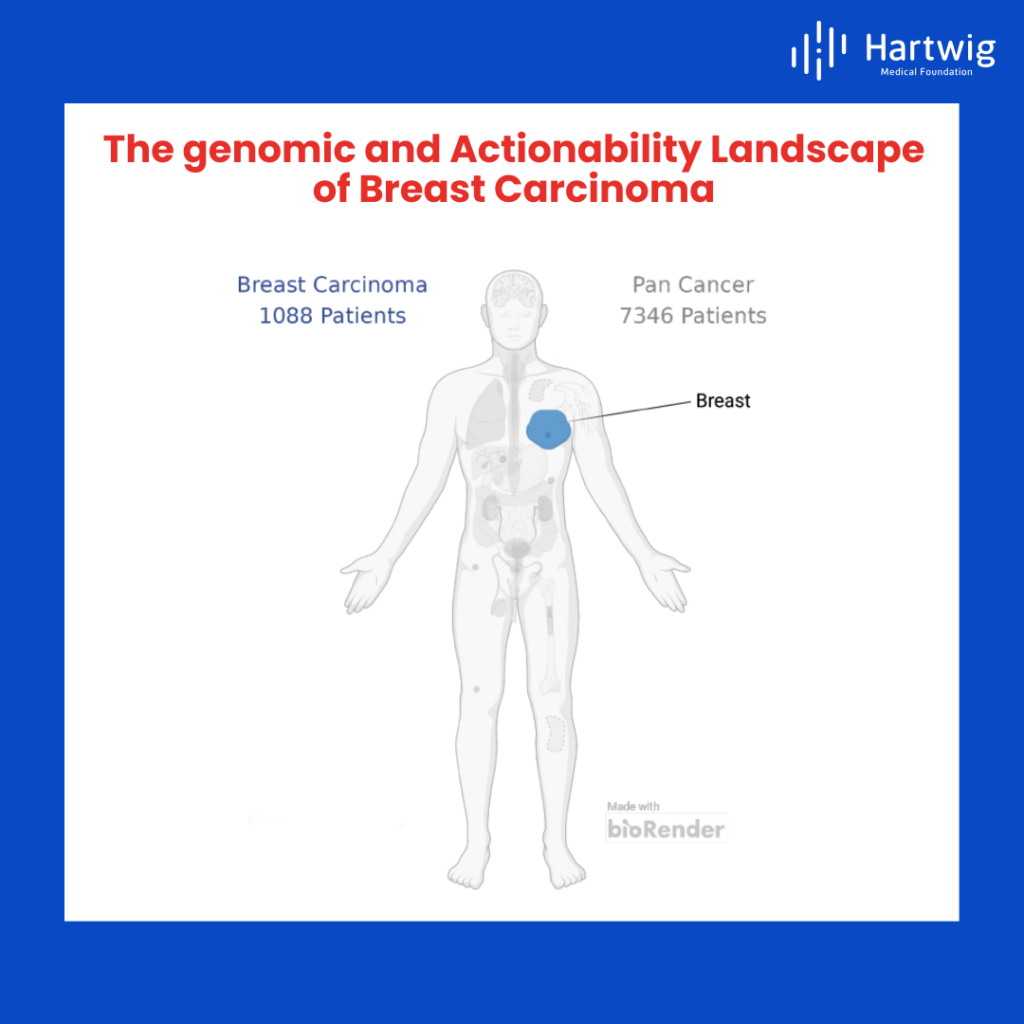
Key Findings
- Clinical relevance in 27% of tumors
In more than a quarter of tumors, genetic features with direct or potential clinical importance were identified, such as homologous recombination deficiency (HRD), mutations associated with therapy resistance, and signatures indicating sensitivity to targeted treatments. “We report personalized genomic information in 27% of breast cancers, representing potential clinical impact for more than 15,000 patients per year in the United Kingdom.” - Predictive value for survival
Genomic data proved to be strong, independent predictors of survival—complementing classical factors such as age, stage, and tumor grade. - New genomic risk framework for ER-positive, HER2-negative breast cancer
The researchers developed a model that allows for more accurate patient stratification:- Low clinical but high genomic risk – calls for more intensive treatment or follow-up
- Low risk on both levels – may support treatment de-escalation
- High risk without targeted options – focus on new therapeutic strategies
WGS as a new triage tool
Because WGS provides a complete overview of all genetic abnormalities, the researchers argue for a shift in mindset: use the genome as the starting point for care, rather than an add-on. “We present a blueprint for using WGS as a triage instrument in clinical care and for enrolling patients in breast cancer trials. In this way, WGS can serve as the first integrated step in diagnosis, treatment, and trial selection.”
Importance of Data and Infrastructure
The findings align with earlier research based on the Hartwig Medical Foundation database (Nature Genetics, 2019), which demonstrated the actionability of WGS in metastatic breast cancer.
The new analysis in The Lancet Oncology goes a step further: by linking WGS to survival data and developing a predictive model, the translation to clinical practice becomes even more concrete.
This progress is largely enabled by national initiatives such as the 100,000 Genomes Project and the NHS Genomic Medicine Service, which collect large-scale genome and outcome data in an integrated way. Without such datasets, it would not have been possible to demonstrate robust associations between genomic profiles and survival—highlighting the value of data-driven oncology research.
Hartwig, together with hospitals and organizations including HealthRI and IKNL, aims to establish a comparable infrastructure in the Netherlands.
More Information
You read an article in the category Learning healthcare system. You may also be interested in Molecular diagnostics, Personalized treatment, Research or Scientific publications.All news
Also read

As chair of the DAB, Mariska Kool will take a helicopter view
Frank van Wijck, science journalist After the departure of Ele Visser, lawyer Mariska Kool from The Data Lawyers took over …
Predicting therapy success based on gene expression
In addition to Whole Genome Sequencing of DNA, Hartwig Medical Foundation performs Whole Transcriptome Sequencing of RNA. Researcher Marjolein Lansbergen …

Dutch Healthcare Institute approves reimbursement of whole genome sequencing (WGS) for targeted cancer treatment
The Dutch National Health Care Institute (Zorginstituut Nederland, ZiNL) has approved the reimbursement of whole genome sequencing (WGS) through the …

The fact that the CPCT, together with Hartwig Medical Foundation, has managed to bundle data, knowledge and expertise from almost all Dutch hospitals is unique and now also deserves international attention.